


The Faith That Didn’t Make It Home
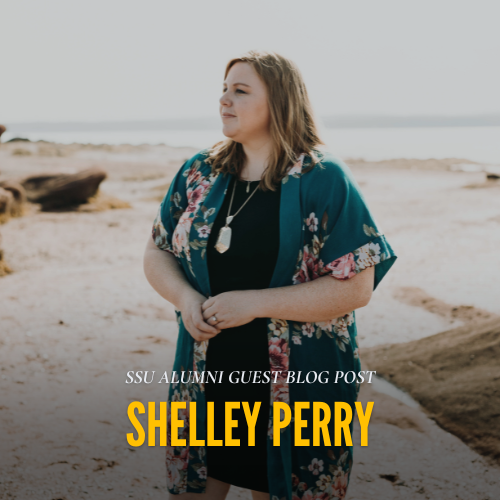
by. Shelley Perry
My deconstruction was a slow boil. I first felt the water warm on a 3-month trip to Africa as an SSU student back in 2001. Born and raised Catholic, I had “converted” to evangelical Christianity as a teenager during the mid-90s. I would never have defined myself as an evangelical, though. No, I was non-denominational, which I believed exempted me from all the negative connotations associated with religion. I didn’t want to be a Catholic, but I also didn’t want to be a Baptist or an Anglican or wear any other religious label for that matter. So, I proudly announced that my faith was “spiritual” and not religious in any way shape or form. I felt absolved - part of a new kind of faith movement that would surely transform the world. I was all in.
The church I attended could have been described as “charismatic” in nature. Certainly not as eccentric as the Pentecostals, but the charismatic flair was there. We had drums and sang Hillsong, Vineyard and Bethel music with cool worship leaders and passionate sermons. We tithed obediently and spent money on “soaking kits” — an airplane pillow and blanket with a Christian instrumental music C.D. enclosed, selling for $80 at the Christian bookstores. We believed we were healing the world — ushering in the Kingdom’s light to our dark communities. But I wanted to reach more than my boring town. I wanted to bring the light to the darkest places of the world — places I understood only through charity commercials and church sermons. I wanted to be a missionary.
When I found out that SSU offered academic trips to the developing world as part of their liberal arts program, I was over the moon. This was my chance. I remember when the university was deliberating my class’s developing world trip in my second year of study. We would either visit Sub-Saharan Africa or Southeast Asia. I had seen other classes leave for Asia, but I knew I was destined to serve God in Africa. After all, there was so much saving to do there! It never occurred to me to ask what, exactly, needed saving. So, one day, in the quiet of my dorm room, I knelt down and begged God to send us to Africa. When my prayers were answered, I quietly assumed responsibility for the decision and tempered my excitement around my fearful classmates.
Our flight departed to Johannesburg less than two weeks after the planes hit the World Trade Centre in New York City in September 2001. As scary as it was to fly in those days, it felt even scarier to stay home. The world was changing and it was changing fast. I couldn’t wait to spend 10 weeks fulfilling my missionary calling in Africa and had no intention of letting a major world event stop me.
Our trip was a mix of academic study and missionary work. We studied apartheid beforehand and immersed ourselves in Nelson Mandela’s Long Walk to Freedom. We learned about the Truth and Reconciliation Commission through the eyes of Desmond Tutu and studied the Mozambican civil war and recent flood devastation. On the other hand, we scheduled visits to local churches, mission organizations, prisons, and an orphanage, volunteering our time while spreading the Word. We crammed into tiny homes to hear testimonies of local believers and to sing and dance to the repetitive beat of a djembe.
The first indication of the water warming happened soon after arriving in South Africa. Our group was visiting a Zulu village where I saw my Western Christian faith merged with local African customs and beliefs in unfamiliar ways. The objects they sold and carried to ward off evil felt superstitious to me; the women moved about topless, and several families practiced polygamy. It was commonplace for women to have children outside of the marriage structure I was taught to revere. In my church community, sexuality and purity were tightly policed, and children born outside of wedlock were a cautionary tale. And yet here it seemed neither shameful nor spiritually disqualifying. In fact, it did not appear to threaten their faith at all. They sang to Jesus and gave God glory for their blessings. Their faith did not appear compromised in any of the ways we were told ours would be. So how was it that we worshipped the same God?
Just as part of me was horrified by these sacrilegious beliefs, another quiet part of me wondered, “is that any different than what we’ve done with Christianity in the west?” My practice of Jesus’ teaching was just as culturally informed. After all, Paul instructed women to cover their heads when praying, and to avoid wearing gold and braiding their hair. Perhaps my uncovered French braid would be seen as sacrilegious by the early Christians. In fact, many of the topless women I encountered were just as horrified by the shorts I was wearing, and I was often encouraged to tie a sarong around my bottom. I thought of our early Sunday morning gatherings, Christmas traditions, and expensive cathedrals – weren’t those things cultural too?
I quietly wondered what this village might be like had Christianity never arrived—what would African spirituality look like had colonizers never landed? I had heeded warnings of occult practices and African witchcraft in this part of the world, so I kept my guard up knowing evil might be lurking in the seemingly innocent crafts sold on the side of the road or in the lyrics chanted by mothers as they worked. Yet the people I met didn’t appear wicked to me. Their art and customs were certainly foreign to me, but they were meaningful and comforting to them. I wondered for the first time if we might be labelling things as sinful that we simply didn’t understand.
These thoughts weren’t consuming, but they were destabilizing. I had come to Africa to help the less fortunate, but instead I was encountering joy, confidence, and a rich culture that I didn’t understand. I brushed off these thoughts—and what I experienced in that Zulu village—as a sobering example of what could happen without guardrails on our faith to protect us. How easily we might stray! I solemnly prayed for the people I met that they might find their way back to the Truth and carried on with my mission.
Yet each subsequent experience in Africa confronted me with similar challenges. As the weeks progressed, I met people who had more faith in their pinky toe than I had every had ever accumulated my entire life – many of whom devoted their lives to faithful service. I “ministered” to the poor only to find a devotion to Christ that put me to shame. Most of all, I began to notice that their faith did not provide them with prosperity I had to come to expect in my Western understanding of spirituality. If “God provides” then why were there so many hungry and unhoused Christians in the townships outside Cape Town and Johannesburg? Either they were living outside of God’s favour, or my understanding of his blessing was wrong. The water was heating up.
I knew the colonial history of South Africa. I knew how apartheid had dispossessed Black families of their land, segregated communities, and imprisoned those who resisted. But in my mind, apartheid belonged to the past — a closed chapter in a history book. Hadn’t democracy prevailed? Hadn’t reconciliation done its work? And yet inequity pressed in on every side. Townships stretched for miles beyond the city centres that were polished for tourists. Grand estates and lush vineyards were protected by electric fences and barred windows. It didn’t take me long to see that while the country spoke of liberation and change, power was still held by the same colonists who had seized it hundreds of years ago. My education had told me South Africa was free. My eyes told me something else.
I wish I could remember every detail of our trip — the names of the mission groups we partnered with, the organizations we served, the benefactor who housed us in a gated villa crowned with shards of glass. We slept behind walls built for protection while preaching hope in communities built from scrap metal and dust. We held babies in orphanages and molded bricks from clay in a refugee village in Mozambique. We drank water carried by mothers with infants tied to their backs and ate meals that were already stretched too thin. And then we evangelized. We offered salvation to people excluded from economic justice and haunted by generational trauma. We sang worship songs over empty stomachs; we spoke of heaven to those denied dignity on earth.
I can’t help but wonder now what exactly we thought we were saving them from. Their faith was not absent, nor was their devotion lacking. What was lacking was justice — and we were not equipped to confront that. I still wonder whether our presence disrupted more than it repaired. I wish I could say our time there transformed lives, but the truth is, I suspect the only life truly transformed was mine.
By the end of my trip the water around me was heating to the point where it would never cool down. No longer did I dream of being a missionary in a foreign land; I dreamed of an equitable world where people were empowered to save themselves. I began to see Christian evangelism as fundamentally inseparable from colonialism — arriving with oversimplified answers, equating unfamiliarity with deficiency, and leaving injustices wholly untouched. It was a relationship I could never unsee.
I still think about the babies in the orphanage that we held close, and the way they clung to us as though we were a life source — babies that we then abruptly left behind. I did not know then what I know now about attachment and disruption, or about how many times a small body can brace for someone to leave before they begin to expect it. We thought we were offering love, but I cannot shake the possibility that we were modeling abandonment.
The certainty I carried onto that plane never returned home with me. I cannot ignore the irony that the trip designed to “serve” others primarily served my own awakening. That awareness feels uncomfortably Western — transformation rooted in someone else’s vulnerability. I am grateful for what shifted in me, but I am unsettled by the possibility that my awakening may have come at a cost I did not understand. I do not know how to reconcile those truths; I only know that the version of faith I carried onto that plane didn’t survive the journey. The water never cooled.
Shelley Perry is a graduate of SSU’s Bachelor of Arts and Master of Arts program and former Registrar of the University. She is currently the Associate Registrar, Admission Services at the University of New Brunswick, where she works in strategic enrolment leadership. With a background in higher education administration, she has spent her career in roles that connect policy, people, and possibility.
She is currently learning the ropes of boutique entrepreneurship with the launch of Marmalade Home & Gift Boutique— a small retail shop located in St. Andrews, NB.
Outside of her professional work, Shelley writes about faith, culture, and history, exploring how political and religious movements shape identity—particularly within the Canadian context. She is especially interested in religious harm and the dismantling of high-demand religious authority. Her writing aims to invite thoughtful conversation rather than easy conclusions. You can find her writing on Substack at - shelleyperry2.substack.com
She lives in Fredericton, New Brunswick, with her husband, Doug, and their very spoiled cockapoo, Gus.