


Reflecting on Faith and Politics
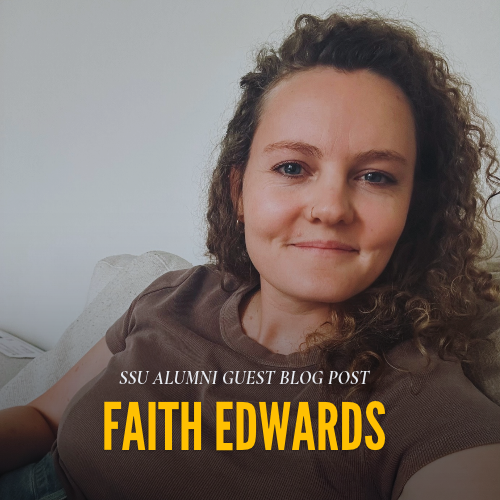
by. Faith Edwards
Recently, I was invited by a family member to share my story with them so they can understand me better and, therefore, facilitate future dialogue between us. This family member and I have dramatically different religious and political beliefs, so in an attempt to prevent the appointment from disintegrating into a heated debate, they suggested we avoid bringing politics or faith into the meeting. It was an interesting thought experiment, trying to consider my story without these spheres as part of it.
Faith has been an integral part of my life since before I can remember. What was once a comforting tool for connection with family and the world around me became the cause of my anxiety and insecurity for several decades between grade school and college. I was raised in a version of faith that saw the world more as hopeless people to be converted rather than fellow humans to be loved. It was a theology, whether it was marketed this way or not, that primarily revolved around the axis of “where are you going when you die?” Experiencing the world that way, as it turns out, is extremely unhealthy. It creates a crisis in your mind, puts your nervous system on overdrive, and affects your relationships with (literally) everyone. Not an airplane ride went by where I didn’t feel like a failure for not evangelizing my seatmate—introversion be damned. Love was defined as being correct and escorting other people into capital-T “Truth” with you. After all, what is love if it allows someone to fall into sin and be a victim of violent punishment for all eternity?
My teenage and college years, therefore, were mostly spent striving to be in the camp of the “saved” rather than the ill-fated “unsaved.” Even more so, they were spent with the inescapable anxiety that it was my job to get as many people “saved” with me as possible before the end of the world. I vividly remember a speaker at my Christian college proclaiming to a group of young adults, “There are souls on the other side of your ‘yes’!” And the applications to the global missions program poured in…
Looking back, that sounds like a whole lot of pressure to put on a 20-year-old. Little did I know this warped theology that required hell as a threat and a reliance on penal substitutionary atonement (heavy on the penal aspect of that theory) is, I suppose, to be expected from within one of the strongest empires to grace the earth. We simply cannot conceive a form of justice that does not require violence. It is so pervasive in the Western church that it goes largely unchallenged, and almost everyone I know who was raised in the church has held or still holds this view today.
The theology of a nonviolent, self-giving God who refuses retaliation and challenges state-sanctioned oppression is very inconvenient for a country that claims that the same God gave them divine permission to steal, kill, and pillage their way across the continent they now call home. It is no wonder this theology was buried and left out of our churches the same way our history of violently conquering innocent people for the resources they stood on was largely written out of our history books.
In my experience, a non-violent Gospel is not even part of the greater American evangelical conversation. The lack of such a theology, in my view, greatly affects our politics. At least for me, in my deconstruction, my understanding of God underwent a dramatic revision. I was confronted with a God who would rather die than kill. Who spent his entire time on earth trying to get us to understand that loving our neighbors and radical forgiveness of our enemies is the only Way to abundant life.
That revision forced me to question the policies I was supporting with my vote. I could no longer ignore the material needs of my neighbors whom political decisions affected the most. I became grossly aware of the lies our government sells to convince us that war is a necessary evil to bring “freedom” across the world, when really it is more about greed and forever expanding our reach. It has become obvious that the men and women in our leadership who claim to be Christians have been deeply informed by the violent gospel, whose savior is Retribution, and where violent conquering is the path to salvation and peace. They no longer even bat an eye as the bombs fall.
When my family member suggested we keep our meeting void of faith and politics, I became confronted with how impossible that task is. Politics (as in the way we go about sharing power and resources) is one stage on which we walk out our faith in practical ways. We cannot talk about helping people without first talking about the systems we find ourselves in. Sometimes, to my chagrin, I have become a person whose faith has deeply changed who I am and has deeply informed my politics. I don’t dislike this because it’s a bad quality, only because it often means I cannot go one day without thinking about the evil in the world, often at the hand of my own country. Sometimes I wish I could just bury my head in the sand and enjoy a coffee without considering the injustices that people likely faced somewhere in the supply chain to get that cup in my hand.
It is for that reason, and many others, that I am so thankful for St. Stephen’s and the beautiful community it has cultivated. Far from skirting the issues of injustice, my time at SSU deepened my perspectives, broadened my point of view, and gave me tools to truly pursue a just peace in whatever ways I can contribute. It has also reoriented me to what is truly mine to do, and reminded me that my hope is not in politicians vainly going about their concepts of justice, but in a crucified God who is in the business of liberation.
At times, I’ve noticed the childhood evangelical in me still feeling the pressure to “save the world.” I know now that I probably won’t save it. Any change I might manage will have to come from deep within, not from an anxious and fearful desire to be “right,” but from the cultivation of genuine neighborly love (and a hint of stubborn refusal of the status quo) that I must allow to extend to my little corner of the world. I don’t need to be “correct” anymore. I just need to be open to those miraculous moments where Divinity is reflected back to me through works of mercy, justice, and hospitality. SSU has been a place where those moments seem to come in frequent succession, and I’m grateful to every person who has been and will continue to be part of that work.
Faith Edwards is an Emergency Nurse in Denver, Colorado, and an aspiring contributor to good and worthwhile things. She lives with her husband, Ryan, in a corner of South Denver and enjoys spending time in the mountains and running. Faith just graduated with her M.T.S in Peace and Justice this May and is passionate about advocating for justice in her community, powered by a theology of peace.