


2026 SA Study-Trip Reflection (PART 1): Back Home from Cape Town. It’s Quiet at 3 am
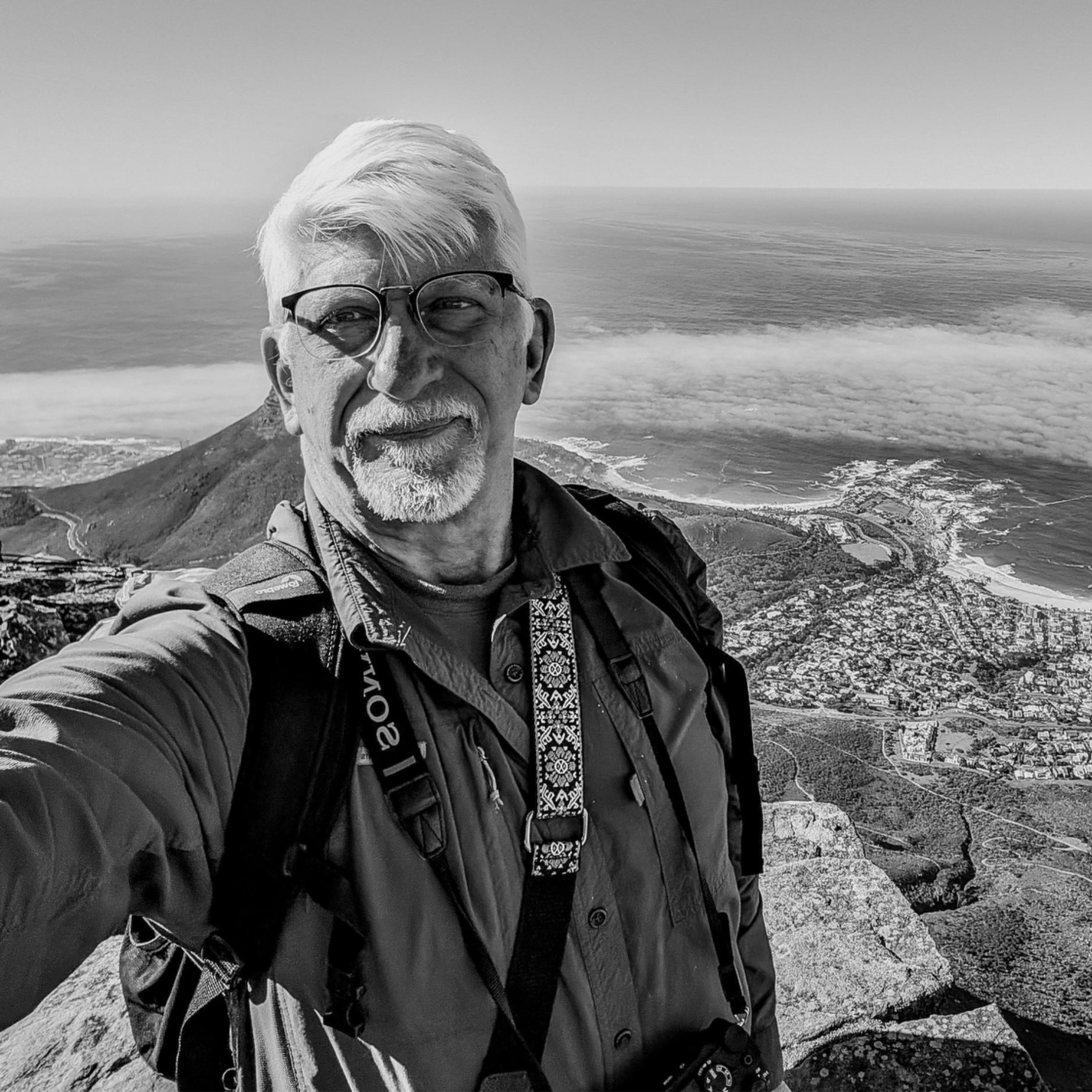

From atop Table Mountain, the city spread out beneath me: Lion’s Head in the foreground, Cape Town and Table Bay beyond it, and—near the top center of this photograph—the low outline of Robben Island.
Only days earlier, we had stood inside the prison where Nelson Mandela spent nearly eighteen years—imprisoned by a regime that regarded his insistence upon equal human dignity and democratic freedom as a threat to the state. Now I was looking down upon it from one of the most beautiful places on Earth.

Then the marathon home began:
Boarded a plane in Cape Town at 8:07 p.m.
Flew just short of fifteen hours to Atlanta.
Crossed the Atlantic and the equator.
Waited five hours in Atlanta.
Flew another five hours across the United States.
Traveled approximately 10,300 miles—about 42% of the way around the globe.
Crossed nine time zones.
Went from winter in South Africa to summer in Seattle.
Arrived home roughly twenty-five hours after boarding.
Trying now to rest and enjoy time with my wife.
Number of coherent thoughts remaining upon arrival: approximately zero.
But clarity, it turns out, is not the same thing as coherence. Even through the jet lag, a few uncomfortable truths are coming into focus.
I am a privileged bastard. I could travel freely through Ireland and South Africa for a month, then board a plane and return to the comfort of my home. Meanwhile, people I sat with in Langa were carving letter openers and selling refrigerator magnets, hoping to earn enough money to feed their children. We were told that five people had been killed in the township the weekend before our visit.
I could enter their world, listen to their stories, take photographs—and leave. They could not leave the conditions that history, race, geography, and economics had constructed around them.
It is nearly 3:00 in the morning. Seattle is quiet, but in Cape Town it is almost noon. The city is moving through another day while I lie awake at home, my body uncertain where it belongs and my mind returning to what I heard, saw, and learned in Ireland and South Africa.
Mandela was imprisoned on Robben Island from 1964 until 1982, then held in other prisons until his release in 1990. Apartheid was formally thrown off with South Africa’s first fully democratic election in 1994. But the structures apartheid created did not disappear when its laws were overturned.
We encountered that unfinished history in Soweto, Langa, Bo-Kaap, and other communities we visited. It remains written into the landscape—in who lives where, who owns valuable land, who travels farthest to work, whose schools have adequate resources, and whose children inherit security or dispossession.
It is easy now, from the safe distance of history, to know what I should say about apartheid. But the harder questions are personal.
Where was I when all of this was happening? What did I do—or fail to do?
When Mandela was still imprisoned and South Africans were struggling against apartheid, I was a missionary in Monterrey, Mexico, doing church work. I preached, taught, built relationships, and tried to serve faithfully.
But did I preach or teach about apartheid? Did I name the systemic racism, forced displacement, and state violence occurring in South Africa? Did I help people understand that these, too, were matters of Christian faith and discipleship?
No. I did not.
It wasn’t that I supported apartheid. I suspect I barely understood it. The version of Christianity that formed me taught me to recognize personal sin much more readily than systemic evil. Mission meant saving souls, building churches, and changing individual lives. It did not often teach us to examine how racial power, colonial history, land, wealth, and political violence shaped the world those souls inhabited.
That recognition is not an excuse. It is part of the confession.
I want to be more than a voyeur—someone who visits the site of a wound, takes photographs, learns enough to say the right things, and then returns safely home. I do not want merely to arrive afterward with the correct interpretation, condemning yesterday’s injustices when doing so costs me nothing.
The question is no longer only, “Where was I then?” It is also, “What am I failing to see now?”
What am I willing to see, say, risk, and do while the wounds of empire are still being inflicted—in Gaza and Palestine, and wherever people continue to be displaced, segregated, dehumanized, and killed?
Solidarity cannot simply mean saying the right things once history has rendered its verdict. It must mean standing near the wound while it is still being inflicted—and risking something in the present, while the outcome remains uncertain and speaking may actually cost us something.
Over the coming weeks, I hope to write more about the people and places we encountered in Ireland and South Africa—and about the connections I am only beginning to recognize among colonialism, apartheid, faith, resistance, reconciliation, and the continuing devastation of Gaza and Palestine.
These will not be conclusions so much as attempts to understand what I have seen, to listen again to what I heard, and to ask what genuine solidarity requires of me now.
Perhaps that is the question I want to leave with all of us:
What is happening in our world today about which people will someday ask, “Where were you? What did you see? And what were you willing to do?”
More soon, as I continue listening, remembering, and trying to understand.
*Interested in joining us in 2027 for a travel-study experience?
visit - ssu.ca/travel-study-experiences
Subscribe to Andy's Substack - Blessed are the Peacemakers
Andy and Cari Conklin-Larsen are peacemakers devoted to engaging their “other” as followers of Jesus Christ, believing this is a core characteristic of true disciples of Jesus. Andy uses his camera to build bridges of understanding between groups and to decrease social distance. His photography has appeared in the National Geographic, Christianity Today, and many other publications. He has also appeared multiple times on local television and radio programs sharing about peacemaking with Muslim communities and peacemaking in the Israeli-Palestinian conflict. In 2011 he was involved for three months in the city of Hebron in the Palestinian West Bank with EAPPI (Ecumenical Accompaniment Program for Palestine and Israel). In the summer of 2022 Andy joined a group of Shia Muslim pilgrims on Ziyarah pilgrimage to Iraq to understand up close the spiritual journey of his friends. The group also met with the Ayatollah Sistani in his home in Najaf. Andy has served with the Evangelical Covenant Church (ECC) since 1988, living in Mexico, Spain, the Middle East and the U.S. in ministries of pastoring, peacemaking, leadership, discipleship, mission and outreach, church planting, and reconciliation. Cari is a community organizer and software engineer who has worked extensively in refugee resettlement, co-founding with a Muslim woman the important “Welcome Home Refugees” to help support and build community around recent immigrants.
Andy and Cari spend much time facilitating encounters with their “other” across the country and in the Middle East, helping disparate communities build relational bridges of understanding, and their greatest passion is to hang out with Muslim friends and get people out of the pew, or off their prayer rug as the case may be, and into relationships with their “other.”